
Summary
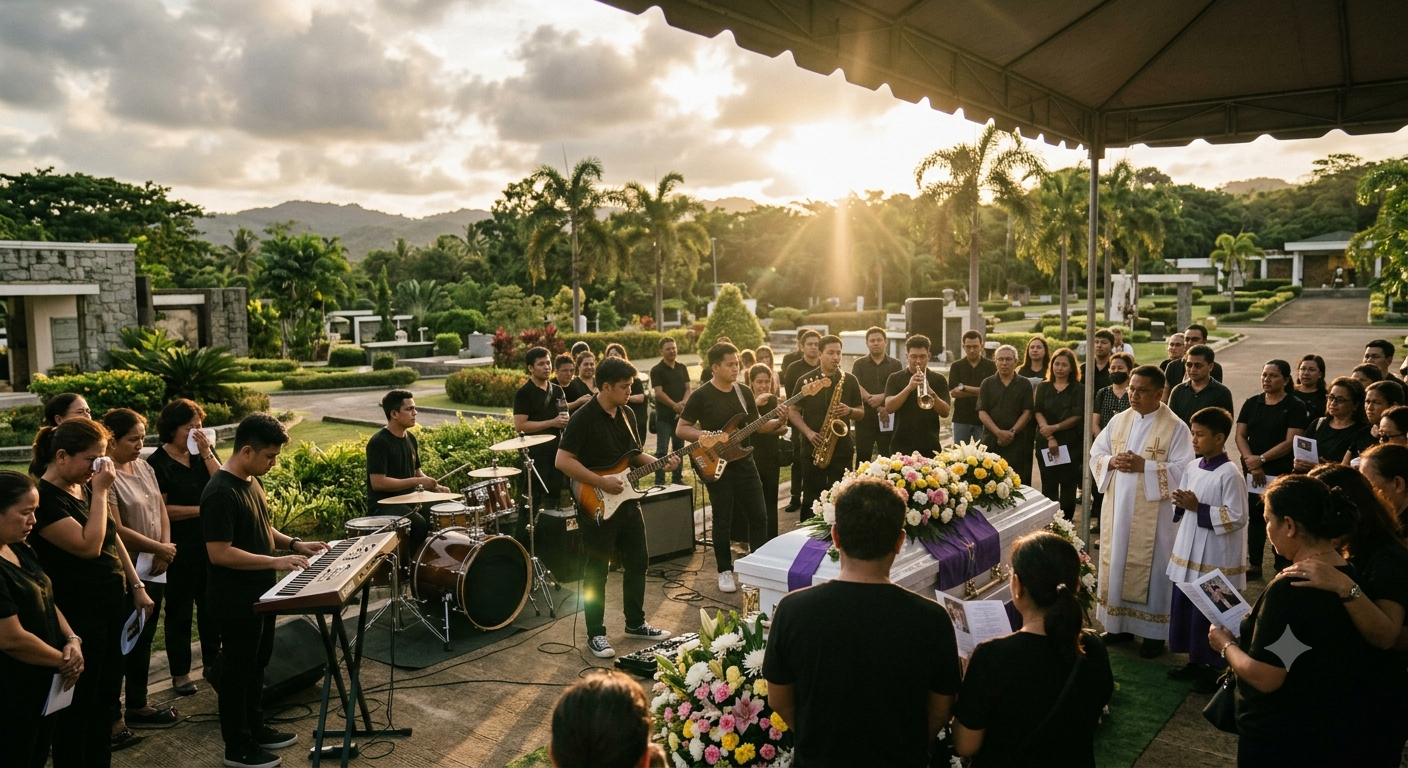
During the COVID-19 pandemic, the untimely loss of several friends and relatives forced me to confront my own mortality. To prepare, I hastily planned my own funeral — but with a twist. While it will include standard Roman Catholic rites, I also want a festive atmosphere, complete with a live musical band. Having survived the pandemic, I look back on that period in this nine-part blog series. These posts serve as both a personal retrospection and a practical guide for my eventual passing. In this first installment of the blog series, I provide context for my funeral plans and an overview of the 44 iconic songs I have chosen for the band to perform.
Table of Contents
- The Pandemic Deaths That Made Me Write My Funeral Plans Down
- Death Acceptance Before the Ink Runs Dry
- How I Chose 44 Songs for My Own Farewell
- From the First Hymn to the Final Lowering: My Playlist Parts 1 to 8
- Post-Funeral Events: My Playlist, the last part. Or is it?
1. The Pandemic Deaths That Made Me Write My Funeral Plans Down
To set the stage for this blog, I want to start with a reflection from the Colombian Nobel laureate, Gabriel García Márquez.
Most of us are familiar with his 1985 masterpiece, Love in the Time of Cholera. Although written over 40 years ago, the novel remains deeply relevant today. It is a profound exploration of unrequited romance, aging, the passage of time, eternal love, and death — the last of which is the central theme of this blog.
A central character of the novel’s love triangle is Dr. Juvenal Urbino, a wealthy and prestigious physician dedicated to eradicating cholera. During this era, the story’s Caribbean port city setting was being ravaged by the disease — an acute, life-threatening intestinal infection caused by the Vibrio cholerae bacteria, which spreads rapidly through contaminated food and water.
Similarly, our contemporary world is all too familiar with coronavirus disease (COVID-19). Sparked by the SARS-CoV-2 virus in early 2020, the pandemic resulted in a truly staggering loss of life, regardless of which statistics you consult.
According to the World Health Organization (WHO) dashboard, the pandemic has claimed over 7.1 million confirmed, laboratory-tested lives globally. Understandably, the WHO’s total death statistics are an understatement. The actual toll is likely much higher due to underreporting, limited testing capacity in many regions, and the fact that many fatalities occurred outside of clinical settings.
As friends and relatives began dying unexpectedly from COVID-19, I realized I could easily become the next statistic. My fear deepened when my entire immediate family members — my wife, daughter, and two sons — contracted the virus. Fearing the worst, I hastily planned my own funeral, operating under the assumption that I would pass away right there in Puerto Princesa City, Palawan Province, Philippines.

Because this journey spans a significant timeline and covers so much ground, I have broken the full story of my funeral plans into a nine-part blog series. This opening installment is featured under “Theme 3: Culture, Customs & Traditions” on my blogging website “Huescribbler.com” after the later one, which was Kaleidoscope Views of the World.
The purposes of this Part 1 in the nine-blog series are threefold. First, I establish
the context for such a funeral, which combines traditional Roman Catholic funeral rites with a live musical band performance.
Second, I provide an overview of the eight upcoming blogs in this first installment. Having survived the pandemic, I wrote this series to serve both as a personal retrospection and as a practical reference guide to help my family navigate my inevitable passing.
Third, I share a glimpse of the 44 favorite songs I have chosen for the live band to perform. I truly believe that traditional Roman Catholic funeral rituals can be transformed into something lively and uplifting when paired with a full band featuring guitars, keyboards, and drums. This concept isn’t entirely without precedent; in the United States — particularly in New Orleans — jazz funerals are a celebrated tradition, utilizing a brass band and a community procession to both mourn and celebrate the deceased.

2. Death Acceptance Before the Ink Runs Dry.
Chronologically speaking, at 64, the reality of death is beginning to feel much closer. Yet, my desire to live remains strong; I’m certainly not ready to leave just yet.
As an itinerant scribbler, I still have a long list of ideas I want to turn into literary pieces and scientific journal articles. There are even a few new paths I want to explore, like vlogging and content creation. At the same time, however, I have accepted that death is an inevitable certainty in this later chapter of my life.
“No one wants to die. Even people who want to go to heaven don’t want to die to get there. And yet death is the destination we all share. No one has ever escaped it. And that is as it should be, because Death is very likely the single best invention of Life. It is Life’s change agent. It clears out the old to make way for the new.”
Source: Quote by Steve Jobs about death from his 2005 Stanford Commencement address
Having been baptized a Christian, I intend to retain traditional Roman Catholic funeral rites. These rituals are beautifully structured to celebrate the life of the deceased, pray for the repose of the soul, and offer comfort to those who grieve. Accordingly, my service will follow the three formal stages typical of Catholic tradition: the Vigil (Wake), the Funeral Liturgy, and the Rite of Committal.
3. How I Chose 44 Songs for My Own Farewell
The major addition to these traditional Catholic rites, however, will be the performance by a live band. I want to shift away from the somber mood typically expected at a funeral; instead, I want the atmosphere to be festive. While death is understandably a time of grief, it can also be transformed into a joyful celebration of a life well-lived.
If either or both are willing, I would love for my former college roommate, Engr. Rodolfo “Budi” Fernandez, or another close friend, Filomeno “Bimbo” Fernandez, to co-lead the live band. Both are versatile guitarists and captivating singers whose music I have always loved listening to.
Engr. Rodolfo ‘Budi’ Fernandez (plays guitar) with Dr. Ed Mangaoang (center) and Engr. Elmer Santos at Room 1208, Men’s Dorm, University of the Philippines at Los Baños, College, Laguna, Philippines. (Photo credited to Engr. Fernandez was taken in either the late 1970s or early 1980s)

Backed by an entourage of talented local musicians — including a drummer, a keyboardist, a lead guitarist, a bassist, and a horn section — they will perform a total of 44 songs. This musical tribute will span from the final night of my wake to the first anniversary of my passing.
Yes, I deliberately settled on 44 songs for two specific reasons. First, it’s a highly practical number for a live band to perform. Averaging 3 minutes per song, it translates to roughly 132 minutes — giving my guests about two and a half hours of fantastic live music.
Second, according to Chinese numerology, “doubled” numbers are considered quite lucky. As such, a total of 44 songs feels like the perfect lucky number for me. (Spoiler alert: I don’t actually expect — or even want — to be resurrected when I pass away!)
My provisional list of 44 songs is ready, and my selection process relied on only two simple criteria. First, I excluded all songs about romantic love. Throughout my life, I have either loved or silently adored the women who captivated my heart. For those relationships that never quite blossomed or were left unrequited, I figure I can just meet them in the afterlife’s cyberspace.
Third, each selection must have a combination of lyrics and melody that personally resonates with me. So, if you came here expecting a playlist of iconic love songs, I am truly sorry to disappoint — this particular blog may not be for you.
But please keep reading and don’t despair! I can assure you that you will still appreciate, and perhaps even personally relate to, most of the songs on this list.
The majority of these songs feature English lyrics. Hence, most were composed by musicians from English-speaking countries such as Australia, Canada, the UK, and the US.
4. From the First Hymn to the Final Lowering: A Playlist Parts 1 to 8.
Don’t worry, I won’t reveal all the details of the 44 songs just yet — not in this first blog installment. I wouldn’t want to spoil the excitement or ruin the anticipation of the incredible setlist my live band will be performing. In case you’re excited.
Rest assured, I will provide a clickable link for each song in its respective blog article down the road. That way, you can listen to — and hopefully enjoy — each track in your own sweet time.
And please don’t be alarmed that I have allocated six songs to most stages of the funeral rites. I promise it has absolutely nothing to do with “666” or the mark of the Anti-Christ! Rather, it is simply a practical arrangement, though I will share a few specific musical details for the descriptions on the final night of the wake and the rite of committal.
Because I have a fully paid St. Peter Life Plan, my pre-need funeral and memorial service package is completely taken care of. As a result, I expect my wake to be held at the service provider’s chapel for at least three days. I actually opted for the top-of-the-line casket (St. Andrews) for one specific reason: so that my only grandson, Marcus Chase (an enterprising three-year-old Filipino-American), can proudly brag that his grandpa is laid in an expensive glass-covered coffin!

In Part 2, I will cover the final night of the wake at the St. Peter Memorial Chapel, where the band will perform six songs. Five of these are tracks from the vibrant world of Original Pilipino Music (the so-called OPM), paired with a single Spanish classic. Here is a clue for that last track: it famously secured second place in the 1973 Eurovision Song Contest.
At around 0900, my funeral entourage will depart from St. Peter for the Immaculate Conception Cathedral Parish. The take-off track for the procession will be Bohemian Rhapsody by Queen, the British band fronted by the iconic Freddie Mercury. Because the procession will move slowly, this short journey will take about 30 minutes to complete. The full narrative of this leg of the funeral journey will form Part 3 of this blog series. Hence, 12 songs will have been performed for the combined Part 2 and Part 3.

In Part 4, I will cover the sacred rituals inside the Immaculate Conception Cathedral Parish. The service will feature a one-hour mass, accompanied by a few eulogies and personal reflections from those in attendance. Hopefully, any friends in politics will take the hint and keep their speeches from running miles long!
While the service takes place, the live band will set up outside the church to play another six songs. One of the featured tracks will be A Horse with No Name by America, the famous musical trio of Gerry Beckley, Dewey Bunnell, and Dan Peek.

After the mass concludes, the procession will move on to Loyola Memorial Park and Garden, which constitutes Part 5. The live band has another six songs ready for this transition, including Highway to Hell by the popular Australian rock band AC/DC. This 1979 classic was famously fronted by lead singer Bon Scott shortly before his tragic passing in London in February 1980. The running total is 24 songs up to Part 5.

Part 6 will cover the remaining funeral chores. The venue for this final farewell is a pre-arranged plot in this scenic seaside cemetery.

We will spend about an hour on the final funeral formalities, including the last verbal tributes from family and friends. To accompany these farewells, the band will perform another six songs, featuring the 1977 number-one US Billboard Hot 100 titled Hotel California by another legendary American band, the Eagles.
The final Roman Catholic ritual, the Rite of Committal, will bring the blog series to a close in Part 7 as my casket is lowered to its final resting place. During this final farewell, the live band will play a sequence of just three songs (running total of 33 songs): Dust in the Wind by the American progressive rock band Kansas; Stairway to Heaven by the iconic British rock legends Led Zeppelin; and finally, The Prayer, performed as a duet by Italian tenor Andrea Bocelli and Canadian female icon Celine Dion. The outcome is the coffin being finally laid to rest.
For Part 8, the focus shifts to a casual gathering, where guests will be treated to a modest lunch right at the venue. (Agree, I will concede: no pork will be served!) The live band will provide the soundtrack with six more songs, featuring the anchor track We May Never Pass This Way Again by Seals & Crofts, an American duo. This addition brings the concert’s running tally to 39 songs performed since the start of the final wake night.
5. Post Funeral Events: My Playlist, the last part. Or is it?
In Part 9, the narrative shifts to the first anniversary of my funeral. The live band will gather at my graveside once more to play a set of five favorite songs. The featured track for this memorial setlist is the classic Reminiscing by the Little River Band from Australia.
This final set brings the total to exactly 44 songs performed. Once again, I find myself returning to the significance of lucky double numbers in Chinese numerology.
If my family members are still up for it, they can re-hire the live band to perform from the second anniversary onward. Playing an additional 11 songs would bring the grand total to 55 — continuing that lucky double-number tradition. But that Part 10 of the whole Funeral plan, if it happens at all, is a story for another time.
I hope you stay with this and see you in Part 2!
***** END OF BLOG *****
REFLECTION FOR READERS
Dear Readers,
Have you ever thought about your own death? Or have you given it any serious thought?
Have you ever attended a funeral service that featured live singers or musicians?
I would love to know your take on my plan to blend traditional Roman Catholic rites with a live band performance to lift the atmosphere and make it a bit more celebratory.
Please let me know your thoughts!
Really can’t wait for the next parts of this story! Huge props to you for tackling the elephant in the room head-on. As Filipinos, we really avoid talking about death—let alone planning out a whole funeral!
Oh, quick fun fact about the number 4 being unlucky: I actually asked a friend about this back when I was studying in HK. Turns out “four” (sì) and “death” (sǐ) sound almost identical in Chinese. Because the base sound “si” is basically the same (slight difference in tone), it created this massive superstition around the number (aka tetraphobia)!
Hi – Prof. Rik! Take a lot for taking the time to read and share your insights. This is my first time to know about the number 4 being unlucky. Part of my lifelong learning!
I really enjoyed reading this, and I’ll definitely be waiting for the succeeding parts.
Just to share, your article reminded me of one of my own thoughts during the pandemic. My uncle passed away during COVID in Brooke’s Point. He was one of the coaches of the drum and lyre team there. A day before he died, his last karaoke song was Bubuka ang Bulaklak. We even have a video of him happily singing and dancing to it. The next day, he suddenly suffered a heart attack. We were devastated by how everything changed overnight, from a joyful celebration to mourning.
What struck me the most was the procession to the cemetery. The entire drum and lyre team in Brooke’s Point accompanied him, playing only Bubuka ang Bulaklak throughout the parade. Nobody was crying; people were smiling and even wondering why that particular song was being played. They didn’t realize that, at the end of the procession, it was my uncle’s funeral car they were accompanying.
That experience has stayed with me and made me ask myself the same question: if it were my turn, how would I want people to remember me? Reading your article also made me sentimental. It reminded me that everything we’re experiencing today, our celebrations, achievements, relationships, and even our plans, will eventually come to an end according to God’s will. It was a humbling reminder to cherish the present while we still can.
That’s why your article resonated with me so much, and I’m genuinely looking forward to seeing the rest of your playlist.
Funny enough, if I ever made my own list, most of the songs would probably be K-pop. 😂 I’m a very avid fan, so I can already imagine my family and friends wondering why they’re attending a funeral with a K-pop soundtrack. 💃🏻💃🏻💃🏻
Hi Mitzi – Thanks a lot for sharing your experience about your Uncle’s death in Brooke’s Point. Death is indeed mysterious as we don’t really know when our time is up. Hope to see you FTF soonest and discuss your K-Pop playlist! Cheers!
Thank for sharing doc Mike. I enjoyed reading ☺️. What a beautiful reminder that funerals can also be a celebration of a life well lived. Carefully choosing your favorite songs to be played during your funeral is a deeply personal way of sharing the music that has brought you joy and defined many moments of your life.It also reminds us that funeral traditions vary across cultures and communities. I remember in my mother’s hometown, for example, it is now customary to hire marching bands during the wake and funeral procession instead of observing the usual Catholic wake rites. While the customs may differ, they share the same purpose -to honor the deceased, comfort the bereaved, and celebrate a life that touched many others. Respecting these diverse traditions allows us to appreciate the richness of our cultural heritage. Looking forward to the succeeding part doc Mike☺️
A blessed Sunday, Engr./Dr. Aynon – Great to hear from you. Thanks a lot for taking the time to read and share your insights. You are correct that the Roman Catholic tradition in the Philippines has been integrated and/or customized into our local customs and traditions. The current funeral practices have new variations from what the Magellan-El Cano expedition had brought to the Philippines in 1521.
I will keep you posted when Part 2 comes out. Meanwhile, I earnestly request that you share this blog to your network of friends and associates. Cheers for now!
I was supposed to read it yesterday but sorry . I went home early because of slight fever. Maybe because of my colds. I just read it this morning (Sunday, while still in bed). While reading it , I also thought of my end and the rituals….but one thing I really enjoyed was the arrangement of the songs you want to play for each part of the rituals. Nice to plan it ahead…. Blessed Sunday !
Good Sunday PP/Dr. Lorie – Thanks a lot for your sharing. I am optimistic that out of the 44 songs, we may agree on at least 50%! For the upcoming Part 2, I am sure that you will agree to my 5 selection of Filipino songs. Do take care.
Taking time to make this comment while riding with Paolo—we’re hauling (frm Batangas to Ilocos) a half-ton load in our pickup truck and refuses to share the wheel—proves I’m taking your blog seriously now! 😂
Most people leave a simple, quiet request for their funeral, but planning a full-blown 44-song concert setlist with a live band—complete with Catholic rites—is the ultimate way to ensure you still get to curate the party, even if you’re strictly attending as the guest of honor. 🤔
Cheers to going out on your own terms—and in absolute style!
Or should I say, What an enviable way to kill death, Mike!
Keep me posted.
Good pm Atty Lowell – Thank you very much that you took the time to read my blog and shared your insights as well. I truly appreciate your time and effort. I hope that Paolo and you have safely arrived in Laoag.
I feel blessed that I have some prominent readers for this particular blog. The earlier ones are academicians – doctors, engineers and professors – including a university vice president. And now you, an accomplished lawyer and a prominent SCUBA diving instructor.
I look forward to meeting you again in my next Ilocos trip. Meantime, I request that you share the blog to your network of friends and associates. Best wishes and warmest regards to both Riema and Paolo.
At first, when I saw the many paragraphs, I’m hesitant to read. I almost opted to just sleep.
But when I started reading it, the words and ideas were becoming interesting.
It’s a unique way and approach in planning a funeral.
Ok, it is good.
But …… we just recently met. We were introduced together by this fish project. I wanted to explore more about Dr. Mike Pido.
So please, be in good shape. Stay healthy. I’ll definitely watch and see the band perform those songs. But in several years from now.
Have a nice day 😊
Hi Dennis – It’s great to hear from you. Thank you for sharing your view.
Although we’ve known each other for barely half a year, we have been enjoying each other’s company. We also have one common academic institution: the University of Sto. Tomas (UST). Your beloved wife used to teach there – while my siblings and two children studied there.
We also love good food, with enthusiasm and gusto. But next time though, we need to eat more veggies and grilled fishes. Although I doubt if we could resist the crispy pata and lechon kawali.
I look forward to our next field trip. Cheers for now.
Looks like you are ready for death. 🙂 I love how you identified the k-pop playlist. Rock-on!
Glad to hear from you, my eldest son. Am ready for the death, if it comes.
Meantime, I am trying to seize the day while still alive. That is “Carpe diem” in a Latin phrase.
How’s the family there in Brevard? I presume my grandson Marcus is now jovially playing with her first cousin, Luna.
I hope you can share the blog to your network of friends there in the US – as well as in the Philippines.
Hi Mike!
Indeed, music is so important in our lives. Do you remember our “create hope” theme song ? Its still in my head. I hear it in my mind whenever I see my mug, T-shirt, clock and pin.
Your article made me think of my own playlist: Blessed Assurance, Amazing Grace, Now I belong to Jesus. Oh I don’t think about death now, the “thief in the night”. Basta for me to live is Christ and to die is Gain (that’s from the bible, I cant remember the reference)
Good am CM Homer – Thank you for sharing your thoughts – particularly with reference to your playlist of religious songs. You are the first musician who has provided a comment to this blog and I am truly pleased with that. I have always admired you playing keyboard in Rotary activities.
Yes, I do remember our theme song among the Top Gun Presidents of RD 3830. I do admit, though, that God has not gifted me with a singing voice.
Meantime, may I please request that you share the blog to your network? Thanks in advance.
I find your blog about death amusing. I just thought about it in passing. But not as detailed as this!
Well, truly life is just a mist that appears briefly then gone before we know it.
Carpe diem!
Hi Doc Pat – Thanks for sharing your feedback. We have so many things in common: former co-workers at PSU; same age bracket at 64; love to do research; and partly philosophers.
At this twilight zone of our lives, we really have to seize our days. Afterall, life is too short to be chasing a unicorn!
Cheers for now.
Hi Sir Mike
Reading this gave me a quiet pause, because I can feel both the weight of the pandemic losses and the love behind how you planned things. Blending Roman Catholic rites with live music is a beautiful way to honor grief and celebration at the same time. I’m glad you and your family made it through, and it makes sense that you’d want your farewell to be filled with music and memories instead of only silence. Thank you for sharing something so personal — it’s both a practical guide and a heartfelt reflection. Praying for you and your loved ones 🙏🏻🙏🏻🙏🏻
Hi Manager Noel – Thanks a lot for taking the time to read and share your insights. I truly appreciate the gesture. I look forward to meeting you again the next time I come back to Puerto. With best wishes to you and your loved ones.
To Prof Mike:
It’s a delightful read, masterfully covering a dark topic without a tinge of macabre. It is on its way to easily achieving its goals as both plan and very worthy content. Of greater consequence, you slyly and forcefully ask your circle: “Come Together right now over me” a la Mr. Lennon, while still interactively able.
By my like age and close call with the grim reaper, the subject and the partly revealed song setlist hit home. You did not refer to your set as (extended) requiem, and quite correctly since as you said they are a celebration of your life. Your choice of celebration medium makes absolute sense, it being trite saying music is a universal language. Words with music (or is it music with words) mimic like no other expression life and living, as to meaning, time, tone, texture, tension, rhythm and pace, with compelling immediacy. Your selections are a journey of shared experience – at turns serious and philosophical (dust in the wind . . nothing really matters) and self-deprecating without being frivolous (highway to hell juxtaposed with stairway to heaven). There is already a lot to unpack from your blog article and being serial you’ve only just begun. (Heard soothing Karen C?)
I have long harbored a similar plan for a playlist for my wake ( a lot longer at thousand and one but not as grand or in-your-face as your live band) and if you have not appropriated “Just a Song Before I Go”, I’ll have it in there.
Andrew
(From the orbit of the formidable and highly esteemed Lowell R)
Dear Sir Andrew,
Greetings from Quezon City!
Thank you very much for your feedback. This is indeed a very pleasant surprise. I truly appreciate that you took the time to read my blog and share your perspective with readers.
Reactions from unknown readers give me immense joy and pride. It implies that I am worth reading. I earnestly thank Atty. Lowell Romero for sharing my blog with you. May I request that you also share this blog with your own network of friends and associates?
Death is indeed a topic that is considered by the majority as an “elephant in the room”. We all know that it’s our ultimate destiny as humans – and yet, we rarely talk about it.
I am glad that we have so much in common musically. Indeed, the Beatles’ “Come Together right now over me” is among the masterpieces of John Lennon and Paul McCartney.
Thank you also for suggesting the “Just a Song Before I Go” by Crosby, Stills Nash & Young (CSNY). Given the number of iconic songs, the rule of thumb I followed was just 1 song per artist or band. What I appropriated earlier for CSNY is another of their iconic songs that you are also familiar with: “Teach Your Children”.
Please let me think about whether I can still bump off another artist’s song to accommodate your suggestion. In fact, I am under pressure now as a few other friends are suggesting excellent songs that are not in my set playlist of 44 songs!
Meantime, may I share this 31st blog about North Korea https://huescribbler.com/the-fascinating-north-korea-part-1-a-prelude-to-an-unforgettable-country/. I hope that you can also share your insights about this unusual country.
I look forward to hearing from you, Sir Andrew. Best personal regards.
Reading the above blog, Dr. Mike, was a distinct pleasure, as I’m certain your recommended blog on North Korea will also be for which I shall find the special time.
I’m absolutely certain you have curated your songs setlist with the same rigor and contemplation underscoring your development of scholarly blog contents, such that please don’t allow me to inject my biases in your song selections.
And I’d be happier called Andrew without the slightest appellation to knighthood. 🙂
Hi Andrew – Thanks for your follow-up message. Please just call me also as Mike. I look forward to hearing from you again. Best regards.
Like you I do have some plans for my funeral too even though I’m not as articulate as you but I do have plans. Just that in the Baha’i Faith we don’t have long wake or embalment.. you have to be buried within 24 hours of your death. So I will be buried according to what is in the Baha’i burial arrangements. I’ll just need to leave a message to my Local Spiritual Assembly to arrange it.
But that’s smart to do it while we’re still alive.and it’s true that nobody wants to expedite it , just that nobody escapes it . Smart move Mike . At least you know what will happen when time comes according to your wishes.
Stay well and see you in January.
Hi Batch Elai – Great to hear from you there in the US. Thanks a lot for reading my blog and sharing your perspective about the Baha’i faith. This is my first time to learn about Baha’i burial arrangement. I am optimistic that the other readers will be enlightened that in your tradition, an individual has to be buried within 24 hours.
I look forward to meeting you again in our upcoming 50th High School reunion next year. Take care for now.
Thanks, Dean Chute.
Good plan. You are my second colleague who talked about death this week. First was my former editor. Maybe I should really be doing some planning too.
Logistically I suggest hiring proper musicians. Reasons are: a lot of songs, different grounds and various phases of the funeral ceremony. I am sure your former college barkadas can still belt out powerful tunes at our current age especially after a few Red Horses. But Professionals will ensure better sound reliability. Maybe a dj if a band is too expensive. Just my two cents pre. Especially baka mag request pa ng karaoke version of Whitney Houston’s ‘I will always love you’ si Miss Elaida Pareja.
Hi Batch Cel – Hello there in Singapore!
I appears that you’re the only one who migrated to another Asian countries. A number of our female classmates went to the US and Ireland.
Thank you for your suggestion that I may consider the option of hiring a professional live band and/or a DJ. I’ll keep that in mind.
Incidentally, I am writing a book (novel) that requires some drawings. You are the drawing artist of international caliber. Just in case, would you be interested to be a collaborating artist? I would be truly honored if you would agree to this proposal.
I look forward to hearing from you. Best regards.
Yes. I count myself fortunate to be in a neighbouring country and which still forms part of the Asian Century.
If it is a graphic novel form you have in mind, I am in, pre. Salamat.
Hi Batch Cel – Thanks a lot for agreeing to be the illustrator for my planned novel writing. I shall send you some notes about it via email.
I look forward to the partnership. Amazingly, it will happen after nearly 5 decades. That’s almost half a century!
Thank you for sharing your blog post to me, Sir Mike. Your writing is always a delight to read, and this particular topic is such an enlightening and delicate topic at the same time. You know what? In my weird personality inside of me, I’ve also thought of planning my funeral ahead of some sort. We are very different in our plans, but the way you planned it and the fact that you actually planned yours is something that validated the same idea in me that, yeah, planning the one’s funeral should not be a taboo, and it’s something that implies the celebration of life of the one who is about to pass, which we all are going to that direction, and for those loved ones of ours who have passed. So, thank you very much for making making me read this, and I will definitely share this blog as well as the idea of embracing our future death in a celebratory way. I also wish and look forward to knowing those 44 songs that you will have on your playlist. For now, longer life, healthier, safer, and happier always, Sir Mike. Thank you.
Hi Prof Archie!
Great to hear from you. I am truly honored and thankful to have received your message all the way from Myanmar.
I am very happy that you are a very successful academic there.
It seems like only yesterday that we were co-faculty members at Palawan State University. You are among the hardest-working faculty members, and you truly deserve that overseas assignment.
I visited Myanmar only once in 2014. Aside from Yangon, we had a socio-economic training at Mawlamyine University in Mon State.
Who knows? I might give you a surprise visit there one of these days.
Do take care. Best personal regards.
Sounds creepy but funny doc mike. I love the songs you mentioned here. It took me sometime to read this in Palawan but while here in Canada I have all the free time in the world. As i reflect on your funeral plan, I thought of it as “hilarious” yet practical. A live band with 44 songs, why not? I love to be there singing with the band, but not soon. I always felt amused whenever I hear stories of a live band during the wake, and you’re planning to have it to yourself? Well, its just a plan though. I love to see you healthy and happy always doc Mike.
Thanks for sharing your thoughts, Ma’am Eva. And for your well wishes too. Cheers from QC!