
Summary
While waiting for my wife at WalterMart in Quezon City, Metro Manila, Philippines, I purchased just a pack of fresh pineapples to satisfy my hunger. I queued in line at the cashier with the least number of customers: one gentleman being served, and two other women ahead of me. To my surprise – and without me making any request – the two ladies voluntarily allowed me to go ahead in line and pay first. Such seemingly simple acts of kindness, given serially, are worth pondering. Altruism as a selfless act for another person’s benefits, without expecting anything in return, is a human trait that is not exhibited by the other species within the Animal Kingdom.
Table of Contents
Homo altruisticus: How a Supermarket Pineapple Redefines Our Place in the Animal Kingdom
Stage Set for Kindness: WalterMart as Humanity’s Unlikely Experience
The Altruism Dividend: 20 Minutes, Two Strangers, and a Ripple Effect
Gender and Generosity: A Feminist Spoiler Alert
Why Blog a Pineapple? On the Survival Value of Small Kindnesses
1. Homo altruisticus: How a Supermarket Pineapple Redefines Our Place in the Animal Kingdom
In a taxonomic sense, we, as modern humans, simply belong to the Animal Kingdom.
The scientific name of modern humans (Homo sapiens) is attributed in 1758 to Carl Linnaeus (1707–1778) - the famed Swedish scientist. Rolled into one as a versatile botanist, physician, and zoologist, he laid the foundations for modern biological taxonomy. In Linnaeus’ system of binomial nomenclature, Homo refers to the genus while sapiens refers to the species. He is often dubbed the “Father of Taxonomy” for his pioneering work in classifying and naming organisms.
The best-selling Israeli author, Yuval Noah Harari, published in 2014 the English version of his famous book titled Sapiens: A Brief History of Humankind. This document provides an intriguing exploration of the history of the Homo sapiens: from evolution in the African continent and how it outcompeted other human species (such as Neanderthals and Denisovans) that also belong to the genus Homo.
Harari’s book is a fascinating blend of various academic disciplines such as anthropology, biology, history, and philosophy. Just like the famous book titled Guns, Germs, and Steel: The Fates of Human Societies by the famed American author Jared Diamond, the book challenges us to rethink our understanding of human history. Harari also argues that humans rule the world because of their ability to believe in ‘shared fictions’ – such as gods, codified laws, and money as a medium of economic exchange.
Aside from Harari’s book, much literature abounds about other traits that make humans superior to other animals. Certainly, humans are capable of cumulative learning. The knowledge that we have amassed are transmitted through and across generations.
Moreover, we possess advanced cognitive abilities. Humans have complex languages, often with grammatical rules. We are likewise capable of higher-order thinking, such as problem-solving and abstract reasoning.
Humans have developed more advanced technology – as opposed to other animals that use just basic tools, such as chimps, octopuses, and crows. Common examples of engineering marvels are our modern towering skyscrapers and massive ancient pyramids. Humans have likewise exhibited large-scale cooperation – where millions of ethnically diverse inhabitants in a given country – are governed by common laws and established institutions.
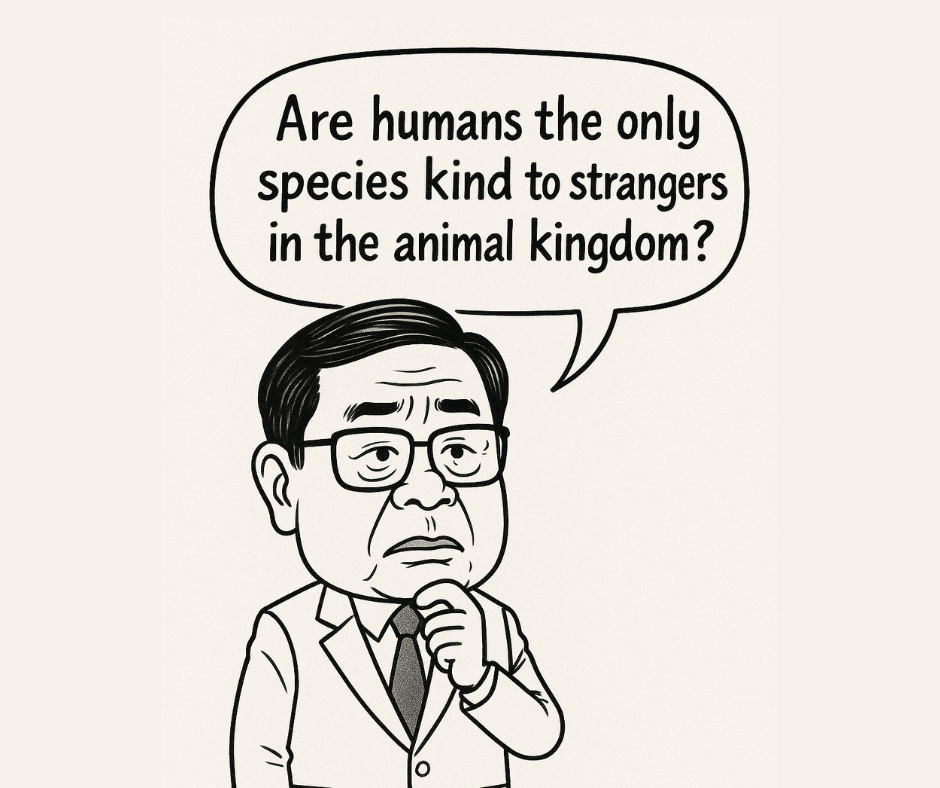
Socially, humans are also capable of altruism – unselfish actions for the benefit of others (Figure 1). (Although I do not discount the fact that other animals are capable of peaceful co-existence, such as ducks mingling with chickens in the same savanna – as well as some cats merrily playing with neighboring dogs.) Categorized under Theme 3 (Culture, Customs & Traditions), this blog’s purpose is to share my narrative about acts of ‘serial’ kindness from strangers that I experienced at a supermarket - of all places. In addition, I provide a discourse that such acts of altruism may have ramifications about our survival as human species in this rapidly changing planet.

2. Stage Set for Kindness: WalterMart as Humanity’s Unlikely Experience
The story’s location was at the WalterMart branch at 222 E. Rodriguez Sr. Avenue in Quezon City, Metro Manila, Philippines. (WalterMart is among the top shopping complexes throughout the country.)
The serial acts of kindness and/or altruism I experienced first-hand from two strangers happened around 1102 on Thursday, 24 April 2025. After my laboratory tests and medical consultations at the nearby Delos Santos Medical Center, I went to WalterMart to meet up with my wife so we could eat together for lunch and do some shopping afterwards. She called up that she would be late, however, as she was still attending some household errands.
Unfortunately, I was already feeling quite hungry. Earlier, my laboratory tests required 10 hours of fasting, and I had not eaten anything yet up to that point in time. My first instinct was to simply buy a flavored hot coffee and some sweetened bread.
Trying to be healthier, however, I went to the supermarket to buy a suitable fruit (Figure 2). Since there was no guava, which was my preferred option being a diabetic, I picked instead a half kilo of fresh pineapple chunks that were sealed in a plastic container (Figure 3). That was the sole item that I took from the fruit section.


When I scanned the cashiering tills, I noticed that the lines of paying customers were unusually long. (Paradoxically, the longest lane [at least 10 people] was the special lane for senior citizens [I belong here at 63-years-old], pregnant women, and persons with disability!) As a result, I queued myself in line at the cashier with the fewest customers: one gentleman registering with his grocery items, followed by two anonymous women ahead of me.
In short, I was the inconspicuous fourth person in line. The two ladies were pushing big carts with them. Due to the volume of their grocery items, I estimated it may take around 30 minutes for the cashier to clear the three of them.
To my utter surprise, the lady right before me abruptly looked behind her. (Probably in her 30s, she was dressed casually in blue jeans and a sports shirt.) Then, she quietly asked me, “Is that pineapple the only item you are paying?” When I responded affirmatively, she said with an innocent smile these kind paraphrased words: “You may go ahead of me. I have many grocery items that may take at least 10 minutes to pay.” Although initially astonished, I said ‘Thank you’ sheepishly. Then, I moved ahead of her on the line. Lucky day for me, I silently mused to myself!
Always ready for a waiting time, I pulled out from my black bag the latest bestseller I’ve been reading more than halfway through already. I refer to Mark Manson’s 2016-released The Subtle Art of Not Giving a F*ck. This engrossing self-help book challenges conventional wisdom about happiness and success – with some contrarian tenets such as the “Backwards Law” (or Inverse Approach to Happiness). I must have lost track of time while reading, standing up, while queuing on the line. That is, until a feminine voice in front of me awakened me from my reading trance: my left hand was holding the book while my right hand was holding the pineapple container.
When I looked up, I saw an amiably-looking middle-aged lady. Dressed in a simple dress, she could have been in her 50s. The gentleman in front had just completed his payment and was re-loading the grocery items in his cart. These were her words as I recall them: “Sir, are you paying only for those pineapple chunks?”
Instinctively, I responded, “Yes, this pineapple package is the only item I would purchase.” Similar to the first lady, she kindly replied with an innocent smile with these paraphrased words: “If that’s the case, you may pay ahead of me. I have loads of stuff to pay that may require about 10 minutes of transaction time with the cashier.”
I sincerely said, “Thank you very much,” then moved ahead of her, and finally paid the cashier for my pineapple item worth PhP36.40 (about US$0.65). Afterwards, I went to the second floor’s food court, sat on the chair of a vacant table, and started munching on the pineapple chunks. I began to reflect on the supermarket event that had just transpired (Figure 4).

3. The Altruism Dividend: 20 Minutes, Two Strangers, and a Ripple Effect Benefits to Act of Kindness?
While mulling at the food court, the first notion that came to my mind was pure luck. Was it a sheer coincidence that I encountered two kind ladies while queuing at the cashier’s lane of WalterMart Supermarket. Was I simply lucky the second time around? Did the lightning’s luck strike twice in the same place?
Assuming that the gentleman at the cashier spent 10 minutes up to paying his bill, the two ladies had gifted me about 20 minutes (10 minutes each) of free time. That saved time was my direct and immediate benefits. Therefore, I effectively utilized such 20 minutes of free time for additional reading and eating of pineapple chunks at the comfort of the food court’s table and chair.
The two women I encountered do not know me at all. Hence, as a complete stranger, they are not obligated to let me go ahead of them at the cashier’s lane. In fact, in terms of time, they lost some minutes while I paid my bill at the cashier.
And yet, without me verbalizing any request, they voluntarily allowed me to pay my bill first. Such seemingly simple acts of kindness, given serially, are worth pondering. This is because altruism – as a selfless act for the benefit of another person, without expecting anything in return – is a human trait that other members of the Animal Kingdom do not exhibit.
4. Gender and Generosity: A Feminist Spoiler Alert
When I shared this story to a feminist friend, she argued that it was not surprising at all. Why? Because the serial acts of kindness were gender-based. Men would not extend the same kind of gestures to me.
She elaborated that had the two women been guys, they would not let me skip the line. More precisely, they would not give a damn that I am a white-haired 63-year-old retiree and a slow-footed grandfather!
She concluded with this paraphrased statement: “Men these days are quite disgusting. There’s a shortage of true gentlemen. The age of chivalry is long dead. Modern men are nothing but a bunch of utility maximizers. The only time that they act generously towards women is when they want to stick their bloody peckers underneath our undies!” Triple ouch!!!
5. Why Blog a Pineapple? On the Survival Value of Small Kindnesses
When I shared with a male colleague my notion to write a blog about the kind gestures of two anonymous ladies at WalterMart’s supermarket, he vehemently disagreed. In fact, he mused these words: “Mike Pido, have you run out of innovative ideas or more exciting experiences to write in a blog?” He argued that the incident was so ordinary and not worth a blogging space. Moreover, he added that if I am in a writing funk, I might as well write an erotica that would certainly titillate my blogging website’s readers!
Logically, his argument makes sense. But in this particular case, I have decided to be a contrarian and write about the incident as my 48th blog post. With a caveat that if my ever-supportive virtual assistant Jade, who doubles as a critique-cum-writing enhancer, may find the blog indeed unworthy, I might consider tossing it in my wastebasket of blogs that never saw the light of the day!
That seemingly simple serial act of kindness from two anonymous female strangers at WalterMart’s supermarket has reinforced my faith in humanity’s more humane relationships between and among each other. They do not know me – and they had absolutely nothing to gain by allowing me to bypass them in the cashiering lane.
Yet these two ladies cheerfully allowed me to go ahead of them. Possibly out of respect – or perhaps they may have even taken pity on me – seeing me as a white-haired and bespectacled grandfather who was reading an orange-covered book about not giving a fuck. I could have been an intriguing sight to them!
I am more inclined to side with the school of thought that doing selfless acts for the benefit of others – who may not be able to repay such charitable gestures – may be necessary for human survival. The altruistic acts for the benefit of others will contribute to the more dynamic perpetuity of the human species (Figure 5).

On larger and more structured scales, the ‘kindness to strangers’ have been exhibited by international volunteer service organizations – such as Jaycees, Kiwanis, Lions, Red Cross and Rotary – through their service and community projects. (I shall share later a distinct blog why volunteer service organizations are among the most significant human inventions.) I have been a member since 2013 of the Rotary Club of Puerto Princesa, Rotary International District 3830, in the Philippines.
In closing, I earnestly express my sincerest gratitude to the two nameless ladies who were kind to me at the cashiering lane at WalterMart’s supermarket on 24 April 2025. They might even remember me if, by any chance, they may read this blog.
And I end this blog with a famous quote from Aesop (c. 620–564 BCE), the legendary Greek storyteller and fabulist. That is: “No act of kindness, no matter how small, is ever wasted.”
***** END OF BLOG *****
REFLECTION FOR READERS
Dear Reader,
That WalterMart pineapple cost just about US$0.65, but the real price was far more revealing: two strangers sacrificing 20 minutes of their day for a man they’d never see again. In our Darwinian world of survival instincts, their actions felt almost…miraculous.
Now I’m conducting an experiment, and your role is crucial. Let’s crowdsource evidence that kindness isn’t just accidental — it’s evolutionary.
Now it’s your turn: Join Humanity’s Kindness Experiment
- Share Your “Pineapple Moment”
Has a stranger’s small act of kindness ever disarmed you? A grocery line gesture, a seat offered, or a coffee paid forward? Comment below — let’s collect proof that Homo sapiens might just mean “wise AND kind.”
- Gender Debate: Fact or Fiction?
My feminist friend claims men wouldn’t have done what those women did. As a reader, what’s your take? Vote quick:
☑️“Gender matters — women are socialized to nurture”
☑️“Nonsense! Kindness isn’t gendered”
- Survival of the Kindest?
If altruism is evolution’s wildcard, how do we engineer more of it? Suggest one way to “design kindness” into daily life (e.g., “pay-it-forward” rules?).
Why This Matters:
Because in a world obsessed with “going viral,” we’ve forgotten the power of going human. Your story + my story = an antidote to the dystopian narratives flooding our feeds.
As Aesop whispered 2,600 years ago:
“No act of kindness is ever wasted.”
Let’s prove the old Greek storyteller right — one pineapple at a time.
Lorem ipsum dolor sit amet, consectetur adipiscing elit. Ut elit tellus, luctus nec ullamcorper mattis, pulvinar dapibus leo.
Haha! Mike this is normal supermarket behavior, at least for women!
Altho it is perhaps a part of human nature! But animals do it too! Dolphins sometimes push stranded swimmers to shore — if a baby elephant falls in a mud hole, the other elephants will gather around and find ways to get him out. Etc. Animals also mourn each other and humans!
Good Saturday, Ma’am Susan – Thanks a lot for sharing your take about the blog. Greatly appreciated.
Am afraid I will be engrossed and read twice your next blog. This one is amazingly true. To me however, what happended was male let me come and go ahead of him to pay my grocers…even in the restos, etcetera, not female. Maybe because am a female and (mebe looking young my age? Or mebe I wore honorable attire? Or possibly am cute or the other way around haha) ..but this just happened to be true and those understanding, considerate Homo Sapiens still exist in this century. Kudos!
Good pm Sis Aime – Thanks for sharing your experience. Perhaps, this blog is divided along ‘gender’ lines! Take care for now.