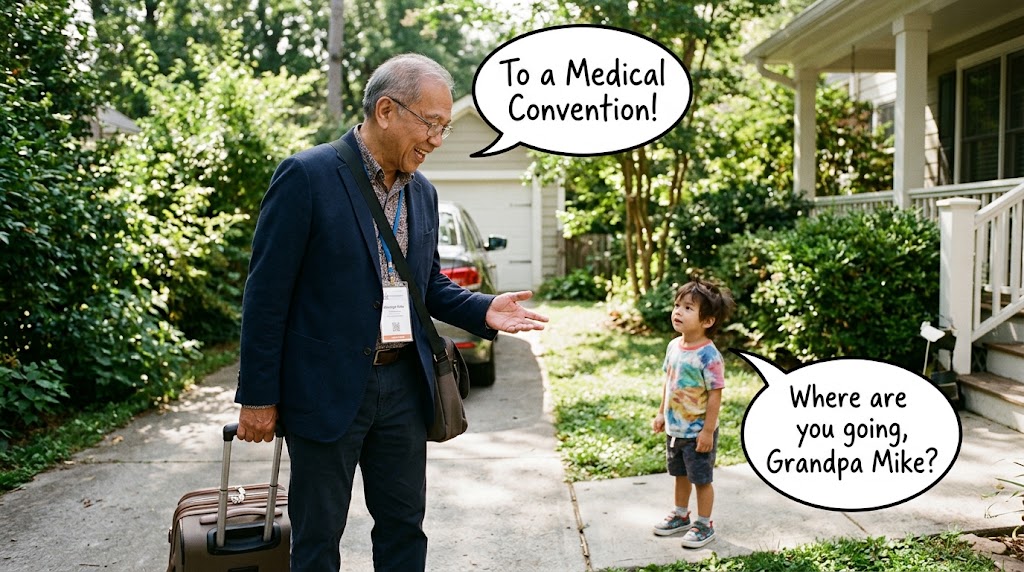

Summary
Turning 60 in the Philippines is a major milestone — you officially become a senior citizen. But what do you call a gathering of men over 60? It is no longer just a reunion; it has become a “Medical Convention.” Why? Because conversations inevitably shift to an assortment of ailments and their corresponding prescription medicines. This blog explores the realities, perks, and medical maladies of becoming a sexagenarian.
Table of Contents
- One Famous Equation, One New Metaphor
- Five Favorite Topics of Filipino Lolos
- A Roster of Ailments and Maintenance Medicines
- The Medical Equation: MC = GOS
- Health: A Senior’s Greatest Asset?
1. One Famous Equation, One New Metaphor
Albert Einstein’s is arguably the world’s most famous equation, proving that matter and energy are two versions of the same thing. While I am not a mathematician and will not attempt to lecture on his Special Theory of Relativity, I want to borrow the concept of an equation as a metaphor. This 56th blog falls under Theme 8 (Health & Wellness) on my website (https://huescribbler.com).

In this post, I will first describe the top conversation topics when senior citizens gather. Second, I will focus on the health issues associated with sexagenarians, including their ailments and prescription medicines. Third, I will introduce MC = GOS equation that I developed. Finally, I will conclude by arguing that maintaining good health is our most crucial asset for longevity and productivity in this new phase of life.
2. Five Favorite Topics of Filipino Lolos
Asian male seniors, particularly Filipinos, eagerly anticipate reunions and informal get-togethers. When these lolos (elderly men) gather, their conversations typically revolve around five main themes:
- Retirement & Benefits: Turning 60 means receiving the coveted Senior Citizen ID, which unlocks 20% discounts and Value Added Tax exemptions on medicines and groceries. Discussions often cover pension payouts (Social Security System or Government Service Insurance System), PhilHealth coverage, local government cash allowances, and transitioning into new income-generating projects.
- Family Pride: A Filipino man’s pride in his 60s is deeply tied to his family’s success. They brag about their children (especially those working abroad) and proudly show off photos of their grandchildren (mga apo). I frequently show off photos and videos of my lone Filipino-American grandchild, Marcus Chase, highlighting his talents and cute antics. Occasionally, the talk shifts to family drama, sibling rivalries, or tips for maintaining household harmony.
- Leisure & Vices: With more free time, casual recreation takes center stage. Many enjoy drinking (inuman) paired with unhealthy finger foods (especially fried pork and other fatty meat products — ouch!), reminiscing about their wild youth. Others focus on backyard gardening, fixing old cars, raising fighting cocks (sabong), or games like mahjong and tong-its.
- Politics & Current Events: Filipino elders are often deeply invested in the political landscape and love a spirited debate. They argue passionately about local and national politics, the rising cost of fuel, and the economy.
- Health & Virility: Health is a dominant, recurring topic, discussed with a mix of serious concern and self-deprecating humor. When the topic turns to sex, they often project an exaggerated image of virility — though, in reality, most of these exploits only happen in their carnal dreams! I will save this highly sought-after topic for a separate blog.

3. A Roster of Ailments and Maintenance Medicines
When male sexagenarians gather, medical updates — specifically discussing “maintenance medicines” — are a standard part of the conversation.
Prescription of some maintenance medicines from my cardiologist in Quezon City, Metro Manila, Philippines. (Photo copyright © 2026 by Michael D Pido)
Below are the top chronic ailments that dominate the discussion, along with examples of their specific prescription medications. I am not endorsing any pharmaceutical products!
- Hypertension: Affecting nearly half of Filipino seniors. Common medications include Losartan (Lifezar, Cozaar), Amlodipine (Norvasc), or Beta-blockers like Metoprolol.
- Heart Disease: A leading cause of mortality among older Filipino men. Many take low-dose Aspirin as a daily blood thinner, or Clopidogrel (Plavix) to prevent clots.
- High Cholesterol: Nightly statins like Atorvastatin (Lipitor) or Rosuvastatin (Crestor) are critical preventive measures. I personally take the latter to keep my cholesterol levels in check.
- Diabetes: Highly prevalent due to age, genetics, and a lifelong heavy intake of white rice. Mainstays include Metformin (Glucophage), Sulfonylureas (Diamicron), and newer drugs like Empagliflozin (Jardiance).
- Joint Pain & Gout: A near-universal complaint. Traditional purine-rich Filipino foods often lead to physically agonizing gout attacks. Believe me, gout is among the most physically agonizing ailments imaginable! Seniors manage this with Allopurinol (Zyloprim) to lower uric acid, or Celecoxib (Celebrex) for sharp pain.
- Prostate Issues: As men age, the prostate naturally enlarges, leading to frequent nighttime urination (nocturia). Tamsulosin (Flomax) and Finasteride (Proscar) are common remedies used to improve flow and physically shrink the gland over time.

4. The Medical Equation: MC = GOS
This brings me to the fundamental question at the heart of this blog. A fellow sexagenarian recently asked me, “Mike, what do you call the event when male senior citizens gather together?”
I immediately responded, “It’s a reunion, of course.”
“No,” he replied. “You are dead wrong.”
I blurted out several terms associated with reunions, such as assembly, celebration, conclave, convocation, gathering, get-together, homecoming, meet-up, and rally.
He jested that they were all incorrect answers and noted the correct term has only recently started circulating.
“Then what the hell is that term?” I queried him in half exasperation.
To which he replied, “It’s a Medical Convention! It’s because our conversations revolve mostly around our ailments and their corresponding maintenance medicines.”
As a struggling influencer, that gave me an idea to create my own equation. (No, this has nothing to do with Einstein’s equation regarding the Special Theory of Relativity in 1905!)
This is my equation: MC = GOS.
Listed below is what the capital letters stand for:
M – Medical
C – Convention
= – Equals
G – Gathering
O – Of
S – Seniors
Simply told, a “Medical Convention is equal to the Gathering of Seniors.” In this context, the term “seniors” refers to everyone from sexagenarians all the way up to centenarians.
Box 1. Age terms by decade of humans.
- Denarian: 10s (ages 10 to 19)
- Vicenarian: 20s (ages 20 to 29)
- Tricenarian: 30s (ages 30 to 39)
- Quadragenarian: 40s (ages 40 to 49)
- Quinquagenarian: 50s (ages 50 to 59)
- Sexagenarian: 60s (ages 60 to 69)
- Septuagenarian: 70s (ages 70 to 79)
- Octogenarian: 80s (ages 80 to 89)
- Nonagenarian: 90s (ages 90 to 99)
- Centenarian: Aged 100 or older
Lest I be accused of plagiarism, I did not invent the term “medical convention.” I do not know who to directly credit, as so many fellow senior citizens have used the coined words lately. My contribution is translating the term into an acronym format.
I sincerely hope that this acronym, MC = GOS, will go a long way after posting of this 56th Blog.
5. Health: A Senior's Greatest Asset?
As we continue to attend gatherings — like my high school Class of 1977’s upcoming 50th reunion in January 2027 — we will reminisce our existence for the last half a century. Understandably, we will have a Medical Convention: swapping health notes on our blood pressure, diabetes, and herbal remedies.
Being functionally alive at 60 is an incredible blessing; as retirees, we are technically living our bonus years. I strongly disagree with the legendary WWII general and former French President Charles de Gaulle who wrote in his memoir, “Old age is a shipwreck.”
To keep the ship sailing smoothly, we must be consistent with our medications, doctor visits, and laboratory tests. I personally monitor my blood pressure every morning and night. Our father (a.k.a. Francis, Kiko, and Pido) passed away due to heart attack at age 64; my elder brother and I have both surpassed that milestone, which makes every healthy day feel like a victory.

Of course, I have coined the equation MC = GOS to add a bit of credential to my blogging chores. Although already a sexagenarian, I still pray to The Almighty to make me a famous international influencer! Over and beyond that, however, our health is truly our most important asset as senior citizens.
I argue that remaining healthy is our most vital requirement for longevity and staying productive as we navigate the terminal phase of our lives. During reunions, the people I envy the most are not those who have accumulated the greatest wealth — they are the ones taking the least, or absolutely no, maintenance medicines at all!

Overall, I contend that senior citizenship remains full of opportunities and endless possibilities. That is, provided we remain functionally alive and reasonably healthy.
***** END OF BLOG *****
REFLECTION FOR READERS
Dear Readers,
Our father died of a heart attack at 64. My elder brother and I have both surpassed that number. That means every morning I wake up is technically a bonus.
So, I thank The Almighty for being functionally alive. I check my blood pressure. I take dutifully my maintenance medicines. I show up to the doctor even when nothing hurts.
Not because I’m afraid of dying — but because I’m not done living. A few days ago, I tried playing pickleball with Jr., our 35-year-old second son. And surprisingly, I still beat him! Was I simply lucky because of my experience in playing badminton, squash and tennis?
Which makes me wonder about the people I sit with at reunions. I don’t envy the wealthiest ones. I envy the ones taking the fewest maintenance medicines.
So, tell me — which would you rather have at 60 and onwards: a bigger bank account, or a body that still cooperates?
Drop your answer below. Let’s chat.