Makalansing na Barya (The Jingling Coins): An Introspection About the Church Gift Offering of Roman Catholics
admin,
Summary
In the Roman Catholic Mass, the Liturgy of the Eucharist includes the offertory — a moment when parishioners contribute cash or in-kind donations. Yet, a persistent joke among Christian denominations claims Roman Catholics are the “stingiest” givers. Why? Because while others pull bills from their wallets, Catholics allegedly dig around for loose pocket change! Is there any truth to this stereotype? In this post, I explore the topic through stories from two priests, reflect on my own giving habits, and look at what it truly means to be a cheerful giver.
Table of Contents
The Question that Initiated this Blog
An Overview of Sunday Mass
Three Meanings Behind the Offering
Two Priests, Two Perspectives
Where Do I Stand as Church Contributor
A Reflection on Love Offering: Beyond the Surplus?
1. The Question that Initiated this Blog
This was the provocative question: “Mike, how can you tell if someone giving an offering in church is a Roman Catholic or a Protestant?”
The question caught me completely off guard. It was a casual Saturday, and I had bumped into a friend and professional associate from a Protestant denomination. We grabbed coffee, and our conversation gradually drifted toward the giving practices of different Christian churches.
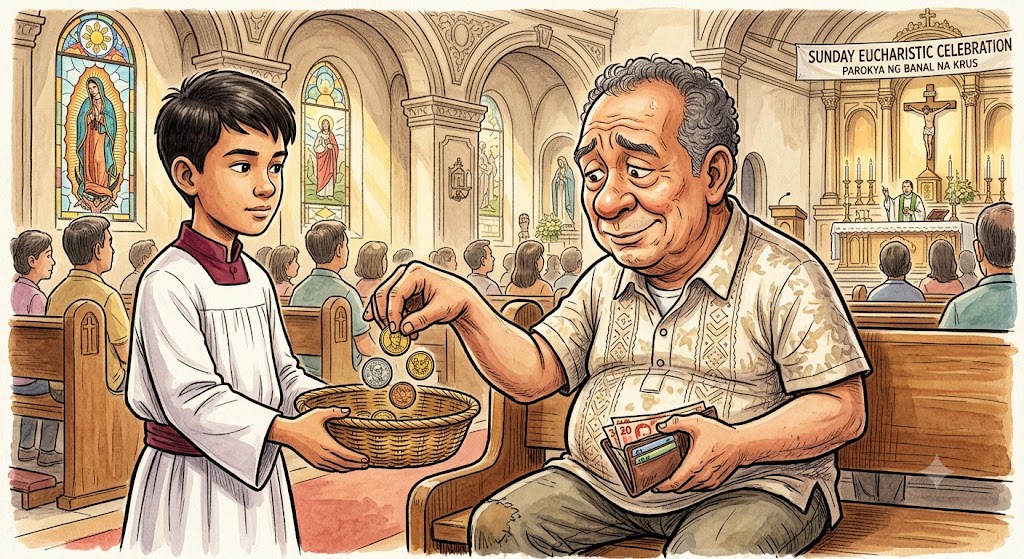
Feeling a bit defensive as a Catholic, I started guessing: “We smile politely during the offering ceremony,” “The women usually handle the money donation,” or “We keep our hands closed so no one sees the amount we give.”
He laughed and told me I was wrong, though my last guess was close. “Here’s the consensus,” he offered with a grin. “Most Roman Catholics fish for coins in their purses, while members of other Christian denominations pull paper bills from their wallets!”
Stingy or Stewards? Rethinking the Catholic Offering. (Source: Image generated using AI Gemini)
This friendly exchange got me thinking about the culture of church offerings, leading to this post’s three goals:
Describe the offertory ritual in the Catholic Mass
Share contrasting perspectives from two priests
Reflect on how we can practice deeper generosity
Given the context about the culture of gift offering in a religious setting, this blog primarily belongs to Theme 3 – Culture, Customs & Traditions in my blogging website. Historical trivia: Roman Catholicism was brought to the Philippines in 1521 by the Spanish Expedition led by Ferdinand Magellan.
2. An Overview of Sunday Mass
To understand where the offering fits in, below is a quick look at the four parts of the Catholic Mass. Although it doubles as a social event, the Mass is regarded mostly as an intimate encounter with God that gives the faithful a platform to seek forgiveness for the sins committed, express gratitude, and receive spiritual strength.
Introductory Rites: The congregation gathers as a community, confesses sins in a penitential prayer, sings hymns of praise, and opens in prayer.
Liturgy of the Word: Attendees listen to scripture readings from the Old and New Testaments. The peak of this section is the reading of the Gospel (there are four Gospels from the original apostles of Jesus Christ: John, Luke, Mark and Matthew). The priest delivers a homily to apply these ancient truths to modern life, and the congregation responds by standing to recite the Creed and offer community prayers.
Liturgy of the Eucharist: The most sacred part of the Mass, reflecting the Last Supper. The community brings forward bread, wine, and financial offerings. The priest consecrates the elements, which Catholics believe become the Body and Blood of Christ, and then leads the Communion Rite.
Concluding Rites: A brief blessing and dismissal, sending the faithful back out into the world to live out their faith.
A pictorial summary of the Roman Catholic mass in chronological sequence (Source: Image generated using AI Google)
The offertory happens during the Liturgy of the Eucharist: people bring forward bread and wine and place monetary gifts in the collection. These gifts support the parish’s operations, outreach, and charitable work.
3. Three Meanings Behind the Offering
The gift offering (alternately referred to as the tithe, offering, or offertory) is far more than a financial routine or entry fee. It represents three dimensions.
The first is a spiritual act of gratitude. A believer acknowledges that his/her talents, health, and wealth come ultimately from God.
The second is the practical dimension. These financial donations sustain basic church operations — building maintenance, utilities, and pastoral staff.
Thirdly, the communal dimension, whereby offerings fund local community outreach programs such as feeding programs and medical missions, as well as global relief efforts. Giving supports the whole community and enables ministries that individuals alone could not sustain.
4. Two Priests, Two Perspectives
During my time in Puerto Princesa City, Palawan, I encountered two very different takes on Catholic giving.
The first narrative is about the long-running joke or allegation that Roman Catholics are quite stingy in gift offering. Revered Father Juan Felipe ‘Pipes’ Torrecampo — known for his lighthearted yet impactful homilies — famously coined the Filipino phrase “Makalansing na Barya” (Jingling Coins). Father Pipes currently serves as Parish Priest of San Jose Parish.
His humor highlighted a funny, albeit embarrassing, reality: many Filipino Catholics tend to give whatever loose change happens to be rattling around in their pockets. Meanwhile, the non-Catholics or those coming from other denominations generously give bills.
On the other end of the spectrum is the perspective of Reverend Father Eleno ‘Lino’ Matas. Father Lino serves as the Formator of Seminario de San Jose. Fr. Lino’s energetic preaching always keeps the congregation engaged. There’s never a dull moment when he officiates the mass as his homilies are full of jokes and entertaining stories.
In one homily on generosity, he challenged the parishioners with a bold, memorable charge: “Empty your wallet!” This take-home message about gift offering has remained in my mind since then. His message is blunt and humorous, meant to provoke reflection about how much we hold back versus how much we trust God with our financial resources.
5. Where Do I Stand as Church Contributor?
As the blogger, you are certainly interested in how much I give. I fall somewhere between the “Jingling Coins Brigade” of Father Pipes and Father Lino’s “wallet emptiers”.
The author’s caricature of gift-giving during a church service. (Source: Image generated using AI Gemini)
During the Mass collection, I typically give ₱100 for the main offertory. Then, I share another ₱20 to ₱50 for the second collection (usually dedicated to church maintenance or special projects). That totals roughly between ₱120 (US$2) to ₱150 per Sunday service.
However, the bulk of my giving happens outside the Sunday collection plate. As affiliated with the Brotherhood of Christian Businessmen and Professionals, I give a regular monthly tithe. Moreover, I contribute significantly to church building projects, fundraisers, and community events.
6. A Reflection on Love Offering: Beyond the Surplus?
Reflecting on this blog brings to mind the Parable of the Widow’s Mite (Mark 12:41–44). While wealthy donors made grand displays of large donations, a poor widow quietly gave two tiny copper coins. Jesus noted that she gave more than anyone else because she gave out of her poverty, while others gave merely out of their surplus
True generosity isn’t measured by the monetary amount, but by the posture of the heart. The real test is what proportion of our blessings we share with God and those in need.
While emptying our wallets every single Sunday might not be practical for everyone, we can certainly move beyond giving just our spare pocket change. Being a faithful Catholic means living out our faith boldly — and that includes becoming truly cheerful givers.
Pope Leo XIV – the first American Pontiff – has neither the charismatic personality of the late Pope Francis nor the flair for dogmatic scholarship of the late Pope Benedict XVI. But I have always admired his heavy emphasis on the spiritual necessity of giving.
Extract from Pope Leo XIV’s Address to Aid Agencies for the Oriental Churches (ROACO), 26 June 2025,that touches about “Joyful and Selfless Giving”
“‘God loves a cheerful giver’ (2 Cor 9:7)… supporting others is not primarily a task, but a mission carried out in the name of the Gospel… a proclamation of joy, which before all else gladdens the heart of God, who never allows himself to be outdone in generosity.”
During an August 2025 Angelus address and within his first major apostolic letter, Dilexi Te (I Have Loved You), he spoke extensively about using personal and material gifts for others. Moreover, he leads by example, exemplifying the hands-on commitment to marginalized communities.
Pope Leo XIV is most certainly the church leader worth following. I will write a separate blog later about why I consider the former Cardinal Robert Francis Prevost, the 267th Bishop of Rome, an organizational genius – and the pontiff with ‘iron’ balls!
For now, this is the rallying point: Roman Catholics of the world, let us be more generous and cheerful givers!
***** END OF BLOG *****
REFLECTION FOR READERS
Dear Readers,
Have you ever paid close attention to how you give during a religious service – whatever is your religious affiliation?
Do you find yourself reaching for loose coins or intentional bills?
Do we reach for what is convenient as just a sense of obligation, or do we offer with mindful generosity?
What does the phrase “God loves a cheerful giver” (2 Corinthians 9:7) mean to you?
I’d love to read your thoughts in the comments below!
Have you ever paid close attention to how you give during a religious service – whatever is your religious affiliation?
Yes. In our church, we are taught to give “ng maluwag sa loob at ayon sa aming ikinagiginhawa”.
Do you find yourself reaching for loose coins or intentional bills?
No. We set aside budget for church offering so that we won’t have to just come up with it when the collector hands out the bag for collections. The amount is fixed, but we make sure to give more whenever it’s our birthday and on special occasions.
Do we reach for what is convenient as just a sense of obligation, or do we offer with mindful generosity?
Not for the convenience, not for the sense of obligation, but with how much you’re heart decides to give because the Lord is more focused behind the attitude of giving rather than how much you are giving.
What does the phrase “God loves a cheerful giver” (2 Corinthians 9:7) mean to you?
Giving should be from a joyful heart, that’s what God and Christ deserves.
In our “ambagan” we use 4 verses: 1 Corinthians 16:1-2, Hebrews 13:16; 3 Juan 7 and also 2 Corinthians 9:7.
Thanks for sharing this blog, Doc Mike. I miss you and PSU, where I used to see you often. Anyway, I am convinced that the kind of giving that pleases God is done freely, joyfully, and with a sincere heart. It is not based on force or pride, but on love, gratitude, and sacrifice, just like what you mentioned about the poor widow who gave her last coins out of trust.
I think there is a difference on the degree of emphasis of giving back money to the church between the Catholics and some Christian churches. Although Catholic churches subscribe to the concept of tithe offering as the Bible spells out (10% of the income) but the imposition among members is not stronger compared with other sect. Rather, I perceived that many of the Catholics give their offering out of the generosity of their heart rather than being grounded with a certain percentage.
Meanwhile, some Christian churches on the other hand underscored the importance of giving back a definite percentage, particularly 10% of their income. I also observed some mechanisms being in place in other churches to collect such amount. Well, perhaps such mechanisms work only for smaller number of believers.
Hmm baka nga pwede QR code na lang yung iflash sa church during offering services😅 so that either piso or thousands wala ng ingay😂
But yes, I definitely agree that true generosity isn’t measured by the monetary amount but by the posture of the heart.
Grateful to you Sir Mike for being generous to me in my lows.
Hi Joey – Great to hear from you. I am glad to hear from you given your affiliation with the Seventh Day Adventist. I always try to learn from those who have different religious affiliation from me.
Most of the Christians I have encountered refer to the biblical 10%. Although there’s no consensus if that is gross or net of the total income.
I have always enjoyed and treasure our friendship through the years. Wishing you all the best there in Iloilo.
Hi Bro Mike. Quite a capsulised view on the Catholic Mass re Offerings or Love Offerings. I tend to agree on the “Kalansing Offerings” of the Catholics as it is evident and obvious during Mass, be it on a weekday or Sunday. Is it because of the hard life or poverty that prevails or the culture influence? Indio treatment in early years? Anyway, nowadays, I do observe that generally kalansings are widespread but I would like to think that it is heartily given and parents even distribute these kalansings to children for them to be the one to give to collectors. Those who are more fortunate give bills and it is also apparent. I would like to think that whatever is offered be it small or large amount are what makes one happy. And when one has been financially blessed, more often, the Church is one recipient of this blessings as commonly shared in the community. It’s the thought and intentions that count. Well, the Church is exempt from Taxation anyway. I do agree that one needs to be a happy giver. Better to give than to receive.
I enjoyed reading the blog, reality bites, just a small fraction of the catholics are really observing love offering/tithes, some church organizations like us in the BCBP its a practice. Love fr. Matas, his jokes make us wide awake during holimies but very straight forward. I think the amount (well this somehow is proportionate also to what we are earning, to some 20, 50 pesos are big enough if they earn very minimal) we give back to church somehow reflects our understanding of the church teachings as well as our gratitude. But still, if it comes from the heart, God will definitely appreciate. Hehehe!
Hi Brod/Director Jec – I am pleased that you have enjoyed reading the blog. Thanks a lot for sharing your thoughts about the mechanism and proportion of giving. As you said, the essence is “it comes from the heart”.
Dear CM,
That’s a very interesting blog. Its a Sunday today and I’m reminded of my giving.
Our model for giving, as Christians should be Jesus Christ. He paid tithes and taxes. He also paid attention to giving to the poor, the widows and orphans. Rotarians have a chance to do this through the areas of focus. Many church lay leaders joined Rotary because giving to the church may not have translated to giving to the poor, widows and orphans.
Blessed Sunday!
Great to hear from you, CM Homer. It’s refreshing to read your perspective as both a Christian and a Rotarian. Indeed, gift offerings are best when translated into on-the-ground actions that help the disadvantaged and marginalized. Best wishes.
Nice and relevant topic doc Mike. As a BCBP member I regularly give my 10% tithes-50% to the church and the other 50-% to BCBP, sometimes even more than 10% from my gross income/pension and our boarding house business. Recently I learned that we also have to give from our agricultural/farm crops and other fruits of the earth. And this is what I’m praying for at the moment, that the Lord will grant me a generous heart for me to start setting aside an amount/tithe from out of our farm harvests. I firmly believe that with a cheerful and willing offering not just a “Kalansing” will continuously bless us financially and physically. God bless



Have you ever paid close attention to how you give during a religious service – whatever is your religious affiliation?
Yes. In our church, we are taught to give “ng maluwag sa loob at ayon sa aming ikinagiginhawa”.
Do you find yourself reaching for loose coins or intentional bills?
No. We set aside budget for church offering so that we won’t have to just come up with it when the collector hands out the bag for collections. The amount is fixed, but we make sure to give more whenever it’s our birthday and on special occasions.
Do we reach for what is convenient as just a sense of obligation, or do we offer with mindful generosity?
Not for the convenience, not for the sense of obligation, but with how much you’re heart decides to give because the Lord is more focused behind the attitude of giving rather than how much you are giving.
What does the phrase “God loves a cheerful giver” (2 Corinthians 9:7) mean to you?
Giving should be from a joyful heart, that’s what God and Christ deserves.
In our “ambagan” we use 4 verses: 1 Corinthians 16:1-2, Hebrews 13:16; 3 Juan 7 and also 2 Corinthians 9:7.
Hi Rai – Thank you for sharing your thoughts. Truly appreciated.
It’s an additional learning for me that there are relevant verses in the bible about giving. Take care for now.
Thanks for sharing this blog, Doc Mike. I miss you and PSU, where I used to see you often. Anyway, I am convinced that the kind of giving that pleases God is done freely, joyfully, and with a sincere heart. It is not based on force or pride, but on love, gratitude, and sacrifice, just like what you mentioned about the poor widow who gave her last coins out of trust.
Hi Prof Harold – It’s great to hear from you. Thank you very much for sharing your perspective.
Take care and best wishes.
I think there is a difference on the degree of emphasis of giving back money to the church between the Catholics and some Christian churches. Although Catholic churches subscribe to the concept of tithe offering as the Bible spells out (10% of the income) but the imposition among members is not stronger compared with other sect. Rather, I perceived that many of the Catholics give their offering out of the generosity of their heart rather than being grounded with a certain percentage.
Meanwhile, some Christian churches on the other hand underscored the importance of giving back a definite percentage, particularly 10% of their income. I also observed some mechanisms being in place in other churches to collect such amount. Well, perhaps such mechanisms work only for smaller number of believers.
Hmm baka nga pwede QR code na lang yung iflash sa church during offering services😅 so that either piso or thousands wala ng ingay😂
But yes, I definitely agree that true generosity isn’t measured by the monetary amount but by the posture of the heart.
Grateful to you Sir Mike for being generous to me in my lows.
Hi Joey – Great to hear from you. I am glad to hear from you given your affiliation with the Seventh Day Adventist. I always try to learn from those who have different religious affiliation from me.
Most of the Christians I have encountered refer to the biblical 10%. Although there’s no consensus if that is gross or net of the total income.
I have always enjoyed and treasure our friendship through the years. Wishing you all the best there in Iloilo.
Hi Bro Mike. Quite a capsulised view on the Catholic Mass re Offerings or Love Offerings. I tend to agree on the “Kalansing Offerings” of the Catholics as it is evident and obvious during Mass, be it on a weekday or Sunday. Is it because of the hard life or poverty that prevails or the culture influence? Indio treatment in early years? Anyway, nowadays, I do observe that generally kalansings are widespread but I would like to think that it is heartily given and parents even distribute these kalansings to children for them to be the one to give to collectors. Those who are more fortunate give bills and it is also apparent. I would like to think that whatever is offered be it small or large amount are what makes one happy. And when one has been financially blessed, more often, the Church is one recipient of this blessings as commonly shared in the community. It’s the thought and intentions that count. Well, the Church is exempt from Taxation anyway. I do agree that one needs to be a happy giver. Better to give than to receive.
Hi Brod Loi – Thanks a lot for sharing your thoughts. I have not totally considered that giving the coins is more of affordability.
As you said, it’s the thought and intentions that count. Loof forward to another round of FTF interaction with you.
I enjoyed reading the blog, reality bites, just a small fraction of the catholics are really observing love offering/tithes, some church organizations like us in the BCBP its a practice. Love fr. Matas, his jokes make us wide awake during holimies but very straight forward. I think the amount (well this somehow is proportionate also to what we are earning, to some 20, 50 pesos are big enough if they earn very minimal) we give back to church somehow reflects our understanding of the church teachings as well as our gratitude. But still, if it comes from the heart, God will definitely appreciate. Hehehe!
Hi Brod/Director Jec – I am pleased that you have enjoyed reading the blog. Thanks a lot for sharing your thoughts about the mechanism and proportion of giving. As you said, the essence is “it comes from the heart”.
Dear CM,
That’s a very interesting blog. Its a Sunday today and I’m reminded of my giving.
Our model for giving, as Christians should be Jesus Christ. He paid tithes and taxes. He also paid attention to giving to the poor, the widows and orphans. Rotarians have a chance to do this through the areas of focus. Many church lay leaders joined Rotary because giving to the church may not have translated to giving to the poor, widows and orphans.
Blessed Sunday!
Great to hear from you, CM Homer. It’s refreshing to read your perspective as both a Christian and a Rotarian. Indeed, gift offerings are best when translated into on-the-ground actions that help the disadvantaged and marginalized. Best wishes.
Nice and relevant topic doc Mike. As a BCBP member I regularly give my 10% tithes-50% to the church and the other 50-% to BCBP, sometimes even more than 10% from my gross income/pension and our boarding house business. Recently I learned that we also have to give from our agricultural/farm crops and other fruits of the earth. And this is what I’m praying for at the moment, that the Lord will grant me a generous heart for me to start setting aside an amount/tithe from out of our farm harvests. I firmly believe that with a cheerful and willing offering not just a “Kalansing” will continuously bless us financially and physically. God bless
Hello there in Canada, Ma’am Eva! Thanks for sharing your experience and perspective as a generous giver.