
Summary
Effectively dealing with all forms of hunger is difficult in any weight loss program. We often succumb to the temptation to eat our favorite high-calorie and fatty foods, and slide back to our unhealthy eating habits. I argue that consuming jicama (a.k.a. singkamas in the Philippines) is a healthier alternative to address our immediate hunger for a snack, or as a complement to our regular meals. Aside from being nutritious with a low-calorie count, this root vegetable is relatively cheap and is readily available all year-round.
Table of Contents
- Turning Weight Loss into a Winning Game: Managing Hunger Strategically.
- How Unhealthy Eating Habits Hijack Your Hunger Signals.
- Jicama/Singkamas 101: Nutrition Facts and Benefits of this Superfood Root Vegetable.
- Jicama/Singkamas in Filipino Meals: A Staple for Freshness and Crunch.
- Jicama/Singkamas as the Ultimate Guilt-Free Snack: Crisp, Sweet, and Satisfying.
- How to Add Jicama/Singkamas to Everyday Meals for Extra Fiber and Fullness.
- Experiment: What Happened When I Stopped Eating Jicama/Singkamas for 3 Weeks?
- Jicama/Singkamas for Long-Term Health: Building Sustainable, Hunger-Proof Habits.
1. Turning Weight Loss into a Winning Game: Managing Hunger Strategically
We all love Jennifer Lawrence – the mysteriously beautiful, highly versatile, multi-awarded American actress.
Among her outstanding portrayals was the character of Katniss Everdeen (a skilled archer), the protagonist in the highly acclaimed film series, The Hunger Games. The movie adaptation is based on a dystopian young adult novel series authored by Suzanne Collins, another American. (The Hunger Games is the first book’s title in the series). Also a television writer, Collins’ book was inspired by reality TV shows, Greek mythology, and her father’s military career in the U.S. Air Force.
Briefly, the story’s setting is in a futuristic country called Panem. This ultramodern nation is comprised of a wealthy Capitol and 12 oppressed districts. Each year, the Capitol requires every district to send one boy and one girl (ages between 12 to 18) as “tributes” to engage in the televised fight-to-the-death competition aptly called “The Hunger Games”. Taking her younger sister’s place in this deadly event, Katniss voluntarily participates as a tribute.
I shall not dwell on the movie adaptation’s struggle about human survival amidst treacheries, rebellions, and political intrigues. Rather, I utilize The Hunger Games film series as a metaphor for our individual ‘hunger games’ about our weight loss programs. Effectively dealing with our respective food hunger will largely determine either the success – or the abject failure – of our end goal of trimming our pot-bellied tummies. Of course, aside from diet, other determinants of a successful weight loss program are a rational exercise regimen, physical activities, and adequate sleep.

Prior to the second quarter of 2025, I have incorporated two innovations into my weight loss regimen. The first innovation was I started using the Lose It App to compute electronically my daily calorie intake. (Our second son, Jr, installed the App in my mobile phone.) Secondly, I have been eating more jicama (a.k.a. singkamas in the Philippines). Given my height of 5 feet and 7 inches, my ideal weight is only about 68 kilograms (kg). At that time, I had already reduced my weight to 82 kg from a high of 93 kg.
The purpose of this blog is to share my story about my jicama consumption to address my hunger for food. (I alternately use the terms jicama and singkamas to mean the same root vegetable.) My narrative includes the following: botanical and nutritional profile of singkamas; its culinary uses; and how I add it as my main dishes’ component ingredient.
The highlight is how I utilize jicama as my go-to snack whenever hunger strikes. I conclude that jicama is a practical go-to food since it is nutritious, cheap, and available all year-round. This blog covers two thematic categories: Theme 6 (Foodies & Culinary Delights) and Theme 8 (Health & Wellness).
2. How Unhealthy Eating Habits Hijack Your Hunger Signals
The most crucial component of any weight loss program is diet – our food intake. Exclamation point! Contrary to some popular advertisements, exercise or physical activity only comes secondary. We, ordinary mortals, shall not lose our unwanted kilos no matter how hard we exercise if we eat like a horse. Simply told, our calorie intake matters the most. And this is where our unhealthy dietary habits come into the equation.
I will take myself as the illustrative example of an incorrigible food tripper. Whenever I feel hungry, I normally take either of my two habitual actions. One is to ransack the refrigerator with whatever food I fancy at that particular point in time. I usually succumb to the temptation of immediately consuming meat products, pastries, or calorie-dense fruits.

The second default action is to open my box of grocery items. As such, I mindlessly rummage through the available goodies. In most cases, I eat salty chips, cream-based cookies, and ready-to-eat noodles. The foodstuffs that I partake – in either refrigerator or box – are mostly processed foods that are high in cholesterol, fats, and calories.

Whatever calories I lost through exercise and long walks, I immediately gain back through cheat meals and mindless eating. There were months when I walked an average of 10,000 steps. But the calories lost (about 500 calories for 10,000 steps) are negated. In most cases, my average calorie intake is over the daily 1,680 calories recommended in my Lose It App.
Rather desperately, I needed a healthier go-to food. And that was when jicama became a ‘food of hope’. Over the past few months, I have been literally forcing myself to partake of jicama slices as either my main snack food – or as a component ingredient in my regular meals.
3. Jicama/Singkamas 101: Nutrition Facts and Benefits of This Superfood Root Vegetable
Internationally known as jicama – but popularly called singkamas in the Philippines – this root vegetable is either round or slightly oblong that is akin to a large turnip. It possesses brown-colored skin that is thin and papery. Its extremely crisp texture and juicy flesh are white, similar to a pear or a water chestnut. Jicama’s flavor is mildly sweet with a nutty undertone.

Classified under the legume family (Fabaceae), its scientific name is Pachyrhizus erosus. It is widely consumed in tropical Asia and Latin America (particularly Mexico). Botanically speaking, singkamas is a climbing vine that produces large, tuberous roots – the crop’s only edible part. Caution: do not consume the stems, leaves, and seeds as these contain the toxic rotenone compound, a natural insecticide!
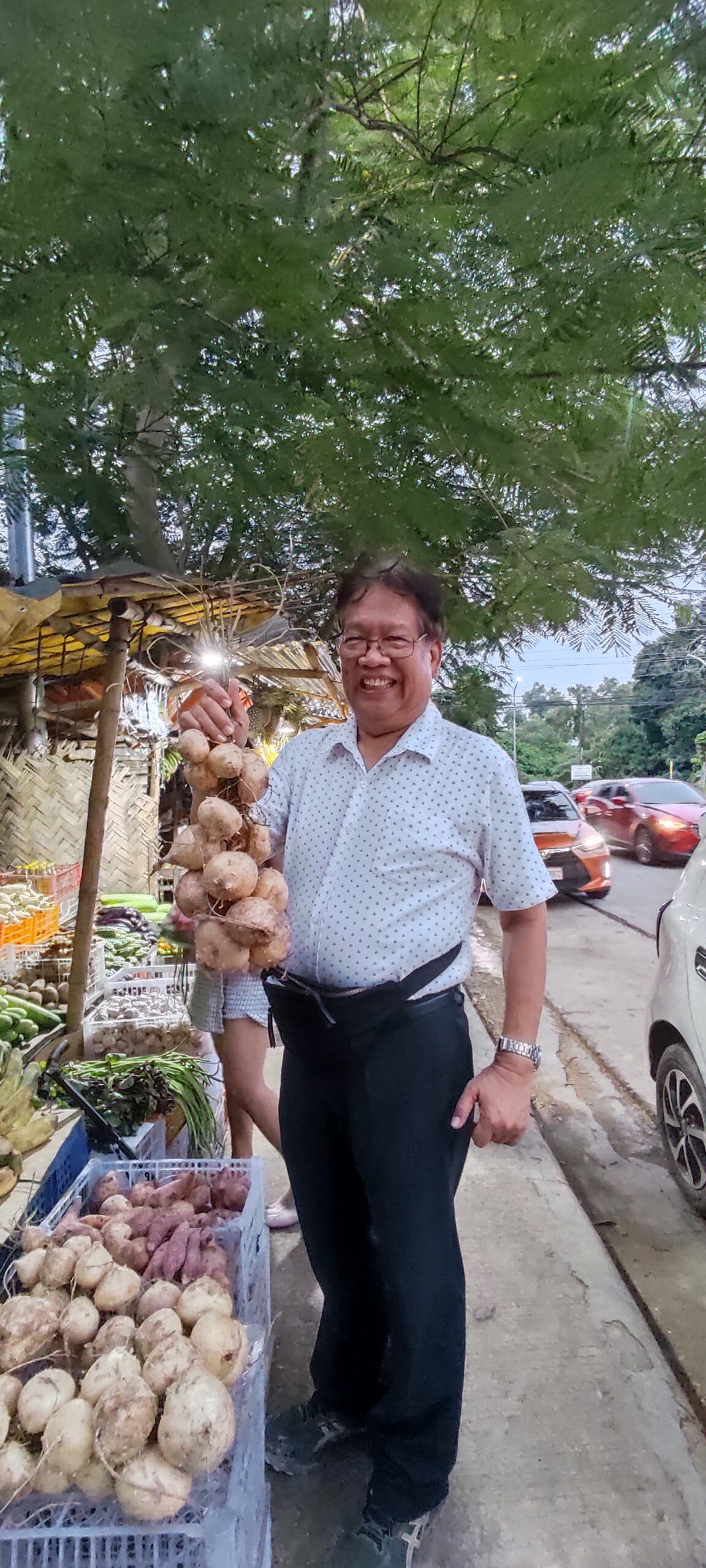
Climate-wise, this root vegetable thrives in tropical and subtropical regions, particularly in well-drained, sandy loam soil. After planting, the roots are ready for harvesting in between five to nine months. Jicama is practically available all year-round. It is also relatively cheap, only PhP150/bundle as shown in the banner photo. (This roughly translates to US$2.60 at the current exchange rate.)
Regarding nutritional profile, singkamas is rich in essential nutrients but low in calories. The macronutrients (per 100 g) are as follows: calories: 38 kcal; carbohydrates: 9 g (primarily fiber); fat: 0.1 g; and protein: 0.7 g. It contains Vitamin C that boosts immunity. Moreover, it contains the following minerals: folate, which is essential for cell growth; magnesium and iron that help in energy production; and potassium that supports a healthy heart.
Singkamas’ health benefits are at least fourfold. One, it is quite safe for a diabetic like me, given its low glycemic index. Since it is high in dietary fiber, it aids digestion, promoting gut health. Thirdly, singkamas has antioxidant properties that help fight inflammation. Fourthly, given that jicama contains 90% water, it’s a hydrating root vegetable ideal for a hot climate like the Philippines and most Southeast Asian countries.
4. Jicama/Singkamas in Filipino Meals: A Staple for Freshness and Crunch
As part of the Filipino cuisine, singkamas has a variety of culinary uses. Many eat it raw with assorted condiments such as chili powder, pepper, salt, or vinegar. A few emulate the Mexicans; that is, partaking jicama with lime.
Jicama is also used as a key ingredient in salads and appetizers. In ensaladang singkamas, it is mixed with green mango, onions, and shrimp paste (bagoong). Like Vietnamese and Thai cuisine, it is also an ingredient of fresh spring rolls, locally called lumpiang sariwa.
To produce an extra tangy taste, Jicama may be added to sinigang (sour soup) in cooked dishes. It may also be stir-fried with other vegetables, similar to Chinese cuisine. Some regions process it in pickled form.
My cardiologist has been cajoling me that since I am a diabetic, I should not overload my diet with meat, carbohydrates, and fats. Given my voracious appetite, however, I can alternatively engage in partaking ‘overload’ of selected vegetables. In this blog, I share the two ways I consume singkamas as part of my vegetable overload.
5. Jicama/Singkamas as the Ultimate Guilt-Free Snack: Crisp, Sweet and Satisfying
First, I now consume jicama as my default snack. That means outside of my three main meals (breakfast, lunch, and dinner), I immediately grab it whenever I feel hungry at home. I normally slice this root vegetable into finger-licking portions and chill them in the refrigerator. Then, I consume it in plain sliced form, similar to those sold by the street vendors.

I have added two modifications when consuming jicama as my primary snack food. First, I drink several glasses of water. That is, until I feel a sense of fullness or a heavy stomach. Why? Because our feeling of hunger does not necessarily mean we are starving or need food. In most cases, we are just dehydrated. Hence, hydrating our body with plain water is the most rational course of action.
The second innovation is putting my sliced jicama container right in the refrigerator’s opening door. I have realized that the strategic positioning of jicama’s container in the chiller is crucial. Why? Because our human tendency is to eat the first food we see to alleviate our hunger. And in most cases, I grab the unhealthy meat products, sweetened breads, and other calorie-dense foodstuffs.

6. How to Add Jicama/Singkamas to Everyday Meals for Extra Fiber and Fullness
I experimented with mixing jicama with other vegetables for my regular meals. These included alugbati (Malabar spinach), carrots, sweet potato leaves, and sayote (chayote). Somehow, singkamas enhances the soup’s flavor and I can eat many slices with minimal calorie count. The ratio of vegetables to meat is roughly 80:20, respectively.

7. Experiment: What Happened When I Stopped Eating Jicama/Singkamas for 3 Weeks?
On 6 June 2025, I was jubilant that my weight was down to 75 kg. That was the scale’s lowest tipping in a long, forgotten time. I attribute eating loads of singkamas – in lieu of carbohydrates and fatty foods – to being a key contributor to such a weight loss.
When my Australia-based daughter Hannah (a medical doctor) arrived for a vacation on 13 June 2025, however, my psyche paradoxically went into a holiday mode. Against my wife’s vehement protestations, I unilaterally declared that period as an eating holiday! As a consequence of such one hundred eighty degrees turn around, my diet regimen had gone wayward.
We went on a one-week family trip to her fiancée’s place in Ilocos Norte on 20 June 2025. After that, I stayed in Metro Manila for 10 more days. It would be an understatement to say that I undertook a gastronomic pilgrimage! As such, I went all-out on a spree of cheat meals of meat products, sweet stuff, and flavored coffees. I had forgotten – if not totally disregarded – everything about jicama.

Given minimal physical activities, I failed to maintain my targeted daily average of 5,000 footsteps. My health regimen was in total disarray. In fact, I stopped using the ‘Lose it’ App that records my daily food intake. I likewise shied away from the weighing scale.
Reluctantly, I finally weighed myself on 10 July 2025. Not surprisingly, I had ballooned to 80 kg. I re-gained 5 kilos within barely a month’s time!

8. Jicama/Singkamas for Long-Term Health: Building Sustainable, Hunger-Proof Habits
I am getting fearful that my weight loss program is akin to a roller coaster ride through the years: a series of ups and downs. At peak, I ballooned to around 93 kg (205 pounds). On 6 June 2025, I was just 75 kg. By 10 July 2025 – as an aftermath of my singkamas hiatus – I had gained 5 kg, which tipped the scale to 80 kg!
Returning to The Hunger Games film series, the main antagonist is President Coriolanus Snow. Donald Sutherland excellently portrays his character as the tyrannical ruler of Panem. Let me paraphrase what President Snow said in one of the conversations. That is, there is one human emotion that is more powerful than fear. And that emotion is hope.
The fear of a downward spiral in my weight loss program has started to creep into my subconscious. To counteract, I re-integrated the consumption of jicama (a.k.a. singkamas) in my diet regimen. Hence, jicama is becoming again my ‘food of hope’ at home. Admittedly, the temptation to immediately satisfy my hunger with unhealthy food is always there.

I have resumed consuming jicama as my primary snack to address my sporadic hunger bouts. I also reverted to including it in my salad veggies and soup-based dishes. As of 23 July 2025, my weight went down to 78 kg.
To reiterate, jicama has many positive features that make it ideal for any weight loss program. It is relatively cheap, nutritious, and available all year-round. Hopefully, eating more singkamas – coupled with an increase in physical activities – may lead me back to 75 kg. And hopefully even lower than that weight.
***** END OF BLOG *****
REFLECTION FOR READERS
Dear Readers,
Jicama (singkamas) became my “food of hope” — crunchy, filling, and a hunger-tamer on my bumpy weight loss journey. What about YOU? Do you agree that this root vegetable is a ‘food of hope’ to address our bouts of hunger effectively?
Have you discovered a local vegetable that gave you that same lightbulb moment?
Maybe it was:
✔ Sayote – steamed and tossed in meals for zero guilt
✔ Pechay – your go-to for volume eating without calories
✔ Kangkong – stir-fried as a midnight snack savior
✔ Gabi leaves (laing) – keeping you full for hours
✔ Or another unsung veggie hero? (Tell us!)
Let us know if your weight loss program is just like mine – a roller coaster ride. Have you experienced losing much unwanted pounds, only to regain them through cheat meals and unhealthy dietary habits? Let’s trade stories! Drop a comment with:
- Your own “jicama moment” veggie
- How it helped your hunger or weight loss
- Your biggest diet struggle (we’ve all been there!)
Please share your thoughts so we can hopefully lose weight together from struggles into strategies. Your tip might be the game-changer someone else needs!
Copyright © 2025 by Michael D Pido
Hi Mike, thank you about your singkamas write up. I shared it to my friends too, which they didn’t know until we read it now.
Hi Ma’am Mayette – Thanks a lot for taking the time to read this blog. I truly appreciate that you’ve shared it to your circle of friends.
I enjoy it plain with salt and ensalada!! I must try mixing it with other veggies 😊
Hi PP Ces! Thanks a lot for sharing your experience. Cheers!
Bro I’m also trying my best to lose weight for the last 3 months. I’ve replaced rice with cucumber, sweet potato and other fruits and its working, I’m losing weight. I guess I have to add jicama to my list now that I’ve read your vlog. 🙂
Hi Brod Ronnie – Thanks for trying out the jicama. Best wishes in your weight-loss program
Thank you for sharing your journey..yah i already read some post about singkamas ..at un rin po ang kinakain ko to reduce my weight…God bless and continue your weight loss sir.❤️🙏🙏🙏
Hi Ann – Glad to hear from you. Now we are on the same page in eating Singkamas. I eat in a variety of ways: raw, mixed with vegetable salad and as flavor enhancer in a meat dish. Thanks a lot for sharing your experience.
Hi doc Mike, I’ll try eating singkamas next time. By the way, have you tried eating a carrots with sesame oil, seeds and pepper? U can also try it, the food source call it nowadays as “eat your retinol” 🙂
Hi Wilde – Greetings there at Opol! Hope all is well with you and the family. Thanks a lot for sharing your feedback.
I have yet to try eating carrots with sesame oil, seeds and pepper. Will do that at the first opportunity – “eating my retinol!” 🙂
If you find time later, may I request that you share the Singkamas blog link to your network of friends and associates? Thank you.